
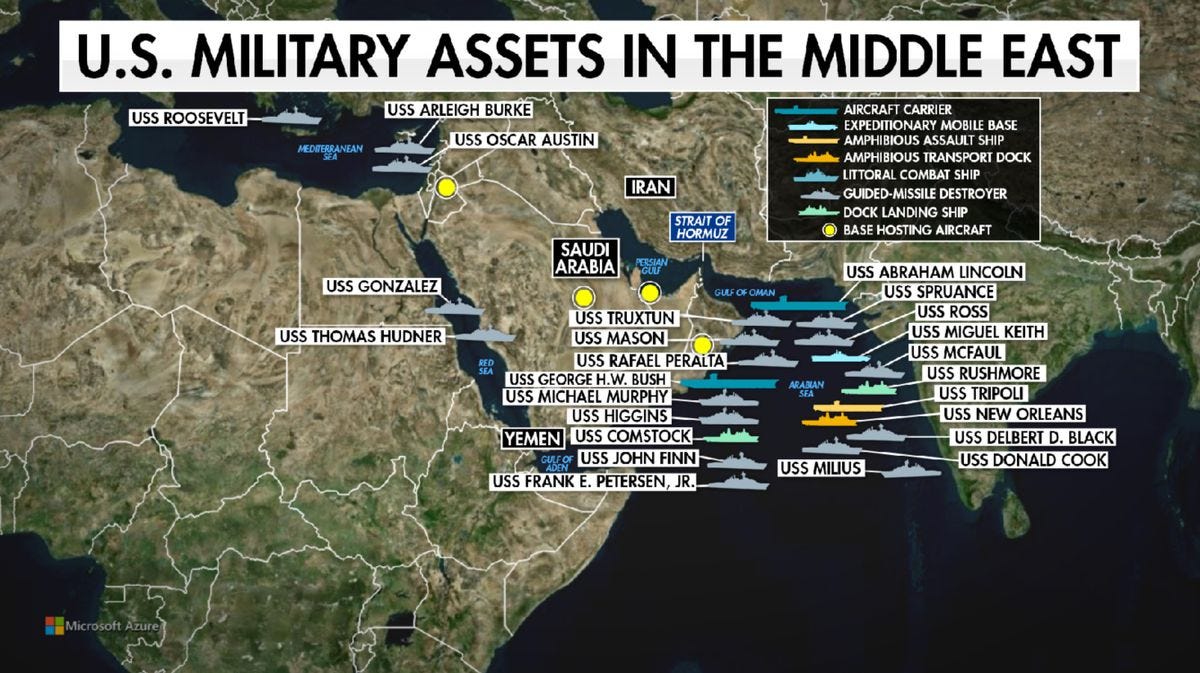
⚓ A newly released image highlighted the scale of the current American military deployment across the Middle East. U.S. Navy officials said nearly 20,000 sailors and Marines are deployed aboard the USS Abraham Lincoln and USS George H.W. Bush carrier strike groups, alongside 18 guided-missile destroyers, the 31st Marine Expeditionary Unit, and more than a dozen air squadrons operating across the Eastern Mediterranean, Red Sea, North Arabian Sea, and Arabian Sea.
The deployment forms part of an estimated 50,000 U.S. troops currently stationed throughout the region. U.S. forces are supporting the defense of Israel, countering Houthi threats, conducting operations involving Iran, and securing maritime routes near the Strait of Hormuz.
🎯 President Trump stated that the United States launched direct “self-defense” strikes against Iranian territory following the downing of an American Apache helicopter near the Strait of Hormuz. According to Trump, more than 20 Iranian military targets were struck, including radar and air defense installations.
Trump said Washington would continue military operations against Iran while negotiations remained unresolved. He stated that the proposed agreement would permanently prevent Iran from obtaining a nuclear weapon and accused Tehran of delaying negotiations despite months of talks. Trump also indicated that additional strikes against Iranian infrastructure, including power plants and bridges, were under consideration.
He later described the Apache incident in greater detail, claiming an Iranian drone became lodged between the helicopter’s pilots during evasive maneuvers. During the same exchange, Trump described Iran’s military capabilities as severely degraded while also stating that his broader objective remained “Peace for the Middle East and the whole world.”
🌍 Trump also addressed regional diplomatic issues, dismissing the likelihood of conflict between Israel and Turkey during his presidency. He stated that Turkish President Erdoğan respected him and that he maintained a positive relationship with Ankara.
Iranian President Masoud Pezeshkian responded that Iran would not yield to threats against civilian infrastructure and said the country would rely on national unity and domestic capabilities to withstand pressure. Iranian lawmaker Ali Khezrian claimed Washington was seeking leverage for negotiations and warned the conflict could expand beyond the region.
🚀 A U.S. official said Iran responded to the strikes by launching at least four ballistic missiles and multiple UAVs toward American bases in Jordan, Kuwait, and Bahrain.
🔁 If this gave you clarity — forward it.
🗨️ Join the discussion, read on web & subscribe by email: https://www.israelrealtime.com/p/subscribe


