
⚠️ U.S.-IRAN CEASEFIRE TERMS EXPAND TO LEBANON AS HORMUZ SECURITY CONCERNS GROW AND U.S. SENATE BACKS PRESIDENT TRUMP'S IRAN AUTHORITY
🔸 CEASEFIRE FRAMEWORK EXPANDS TO LEBANON: Tehran, Washington and their allies announced an immediate and final end to the war on all fronts. According to Bloomberg's reporting on the memorandum of understanding, the parties pledged not to launch hostile acts or issue threats against one another.
Lebanese Deputy Speaker Elias Bou Saab told Al-Mayadeen that the upcoming U.S.-Iran interim memorandum of understanding mandates an immediate cessation of hostilities inside Lebanon and integrates the country into a broader regional stabilization track.
A multinational oversight committee consisting of the United States, Saudi Arabia, Qatar and Iran has been proposed to supervise border stabilization efforts and verify a comprehensive Israeli military withdrawal.
Bou Saab said multi-phased Hezbollah weapons handovers south and north of the Litani River face operational difficulties due to internal concerns over possible Israeli ground incursions after disarmament.
He added that full implementation of the Taif Constitution and subsequent cabinet changes would expand state authority, with Speaker Nabih Berri serving as a key complementary guarantor alongside the Washington negotiations.
Bou Saab also said diplomatic normalization with Tehran is actively advancing and described Lebanon's previous rejection of Iranian Ambassador Sheibani's credentials as a "critical strategic error."
⚠️ REPORTS OF POTENTIAL IRANIAN RETALIATION: According to American media reports, Iran may launch a surprise attack against Israel without warning in retaliation for events in Lebanon.
⚓ HORMUZ SECURITY REMAINS A MAJOR CONCERN: CNN reported that leaked memorandum provisions require Iran to conduct comprehensive de-mining operations throughout the Strait of Hormuz.
RAND analysts cited by CNN said Iran possesses basic sonar-sweeping capabilities but lacks the precision required to reliably locate specific naval mines. U.S. military intervention remains an active contingency if Iranian efforts stall, using American tracking data to destroy priority targets and reopen commercial shipping lanes.
According to CNN, U.S. intelligence assesses that Iran retains the ability to block the Strait of Hormuz whenever it chooses. One intelligence assessment cited by the network described the waterway as "a weapon stronger than nuclear."
NBC reported that Iran has already launched multiple drones toward commercial vessels operating in the Strait of Hormuz since the signing of the U.S.-Iran memorandum of understanding.
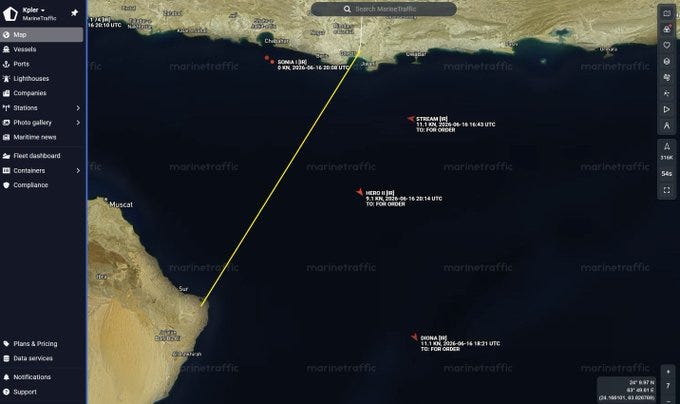
⚓ IRANIAN OIL EXPORTS RESUME: According to TankerTrackers, Iranian VLCC supertankers DIONA and HERO2 departed carrying a combined 3.8 million barrels of crude oil, marking the first reported maritime energy exports since the start of the two-month U.S. naval blockade.
A third NITC tanker, STREAM (IMO 9569633), is approaching the active blockade line after spending seven weeks idling inside Pakistan's exclusive economic zone.
🇺🇸 U.S. SENATE BLOCKS WAR POWERS RESTRICTION: CNN reported that the U.S. Senate blocked a resolution that would have restricted President Trump's authority to conduct military operations against Iran without congressional approval.
The measure failed in a 47-48 vote, halting an effort to require congressional authorization for future military action against Tehran.
The vote followed last month's narrow 50-47 procedural victory by supporters of the measure, underscoring the closely divided margins.
Vice President JD Vance reportedly bypassed Senate Majority Leader John Thune to brief selected senators via conference call amid bipartisan demands for a congressional vote on any final agreement.
🔁 If this gave you clarity — forward it.
🌐 Full updates & discussion: https://www.israelrealtime.com


