
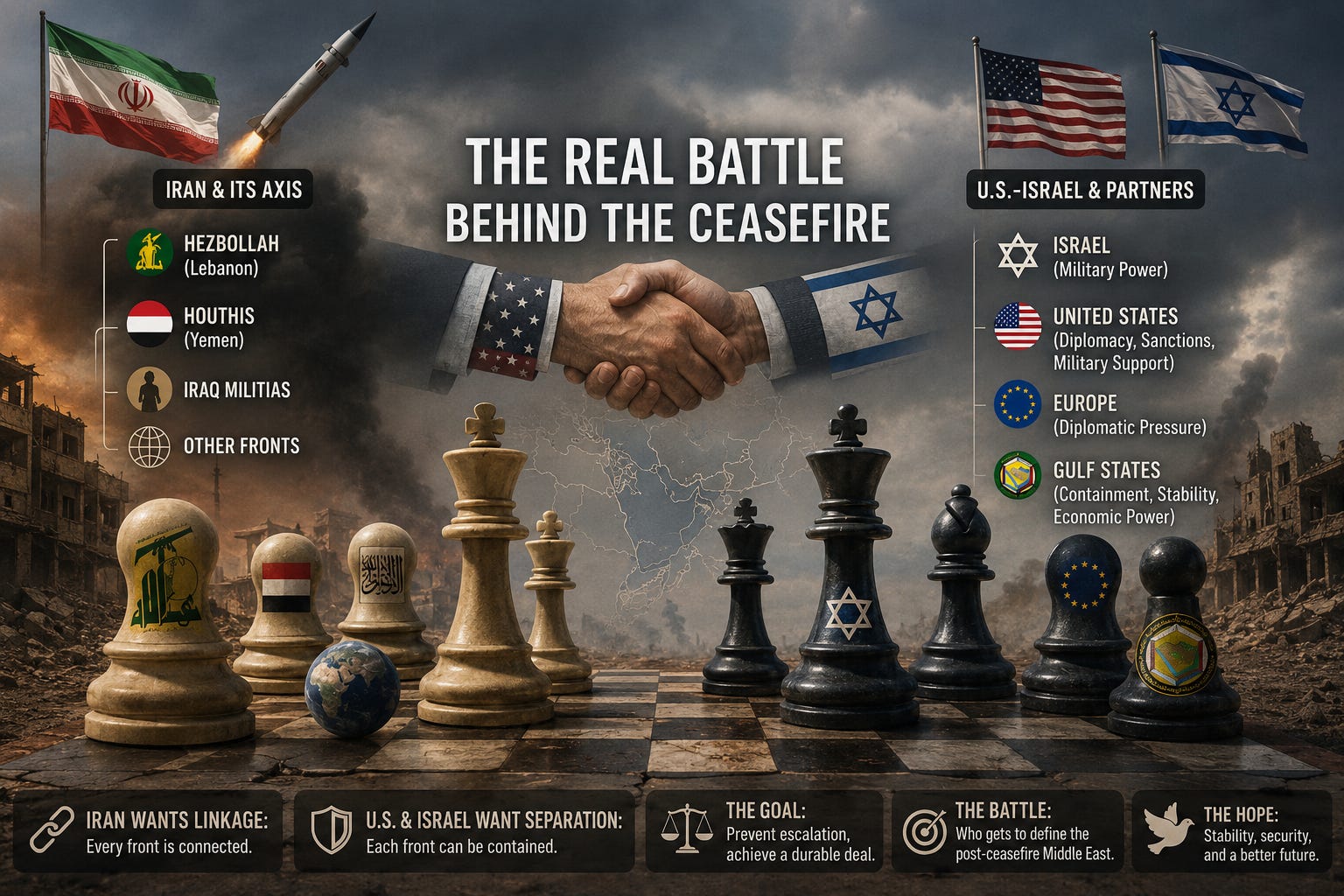
The Real Battle Behind the Ceasefire: Iran’s Axis vs. the U.S.-Israel Order
President Trump’s statement about an immediate Israel-Iran ceasefire raised the central question of the moment: if peace is truly close, why is the region suddenly moving toward escalation?
The answer may lie less in the missiles themselves and more in what each side is trying to prove before the diplomatic framework hardens.
For months, the core negotiations have largely been between Washington and Tehran, with Israel deeply involved strategically, but not necessarily the direct negotiating counterpart. Iran does not want the talks reduced to a narrow nuclear deal. It wants the negotiations to recognize Iran as a regional power whose influence runs through Lebanon, Yemen, Iraq, and beyond.
That is why Lebanon suddenly became so important.
From Israel’s perspective, the equation is simple: if Hezbollah fires at Israel, Israel retaliates. Stop the fire, and the retaliation stops. Israel’s growing message has been that continued attacks from Lebanon could bring direct consequences to Beirut itself.
For Iran, however, Beirut is not just another target. Beirut represents Hezbollah’s political and strategic center — Iran’s most important forward deterrent against Israel. If Israel can repeatedly strike Hezbollah-linked targets in Beirut while Iran remains quiet, the entire “Axis of Resistance” risks losing credibility.
That is likely the deeper reason behind Iran’s response.
The missiles themselves caused limited damage, but the purpose was not only military. The message was strategic: Hezbollah cannot be separated from Iran, and Lebanon cannot be detached from the broader regional equation.
Yemen fits into the same pattern. The Houthis’ missile launches and Red Sea threats were likely less about battlefield results and more about reminding the region that Iran’s network can still pressure multiple fronts simultaneously — including maritime trade and global shipping routes.
This is Iran’s leverage: instability.
Iran cannot match the U.S.-Israel side conventionally. It cannot compete with American global power or Israeli intelligence and airpower. But it can create enough regional pressure to force the world to negotiate around it.
The U.S.-Israel strategy appears to be the opposite.
Iran wants linkage.
America and Israel want separation.
Iran’s position is that every front — Lebanon, Yemen, Gaza, the Gulf, and the nuclear issue — is connected. The U.S. and Israel are trying to establish the opposite: that each front can be isolated, contained, and pressured separately, preventing Iran from using every proxy as a veto over regional stability.
That is the deeper strategic clash now unfolding.
Europe plays mostly a diplomatic role, pushing de-escalation and negotiations. The Gulf states are more conflicted. They fear Iran, but also fear a regional war that could threaten energy infrastructure, trade routes, and economic stability. Their goal is not total confrontation, but controlled containment.
This may also explain Trump’s warning about “ignorance or stupidity.” Psychologically, it sounded less like random rhetoric and more like a warning against brinkmanship near a possible deal. The implication was that the major actors may already see a path forward, but secondary escalations, proxies, hardliners, or miscalculations could still destroy it.
That is why this moment feels so contradictory.
The closer the region gets to a possible agreement, the more each side tries to shape the balance before the framework becomes permanent.
Israel is trying to lock in deterrence.
Iran is trying to preserve regional linkage and the credibility of its axis.
The United States is trying to freeze escalation before it spirals further.
So the missiles themselves may not be the main story.
The real story is the struggle over who gets to define the post-ceasefire Middle East.
🔁 If this gave you clarity — forward it.
🌐 Full updates & discussion: https://www.israelrealtime.com


