


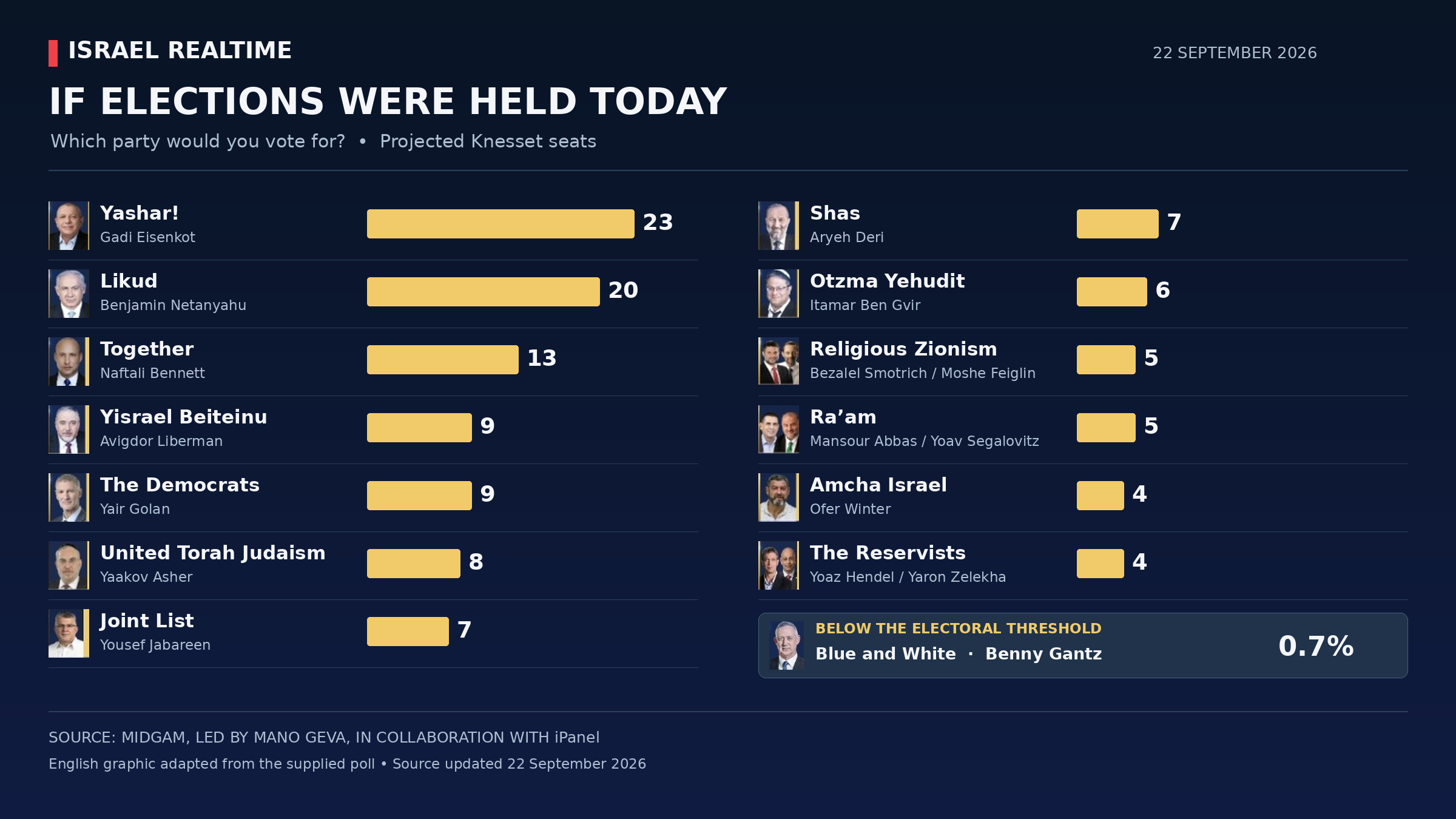
🗳️ Elections: unchanged bloc arithmetic and competing political plans: The September 22 News 12/Midgam poll leaves both major camps short of a majority: Netanyahu’s bloc has 50 seats, the non-Arab opposition 54 and the Arab parties 12, with Hendel-Zelekha’s four seats counted separately. Even if those four joined the non-Arab opposition, it would reach only 58. Netanyahu’s bloc remains eleven seats short of 61.
The party projections are Yashar 23, Likud 20, Bennett 13, Democrats 9, Yisrael Beiteinu 9, UTJ 8, Joint List 7, Shas 7, Otzma Yehudit 6, Smotrich-Zehut 5, Ra’am 5, Ofer Winter 4 and Hendel-Zelekha 4. Compared with September 14, the Democrats lost one seat to Yisrael Beiteinu, while the Joint List lost one to Ra’am. Yashar, Likud, Bennett, Smotrich-Zehut, Winter and Hendel-Zelekha were unchanged, as were all bloc totals.
Threshold survival remains consequential for Winter and Hendel-Zelekha. News 12 provided no exact vote shares; Maariv/Lazar’s September 18 poll put them at 3.4% and 3.5%, just above the 3.25% threshold. The September 17 i24/Direct poll gave Winter five seats but placed Hendel-Zelekha below the threshold at 2.2%. The comparison suggests Smotrich-Zehut is more consistently viable, though still close to the danger zone.
Netanyahu improved personally without gaining Likud or bloc seats. Against Bennett, he moved from trailing 39%-40% to leading 41%-37%; against Eisenkot, he narrowed a 36%-42% deficit to 38%-41%. Much larger differences persist between pollsters: recently cited i24/Direct and Channel 14 polls gave Netanyahu’s bloc 60 and 64 seats respectively. With each series relatively stable internally, the 10-to-14-seat gap primarily points to pollster and model differences, rather than establishing a comparable voter swing. Trump also shared an article describing an Israeli poll as putting Netanyahu’s bloc in the lead.
⚙️ Israeli defense investment, emergency services and border security: The Finance Ministry and DDR&D selected Adir Capital, part of Idan Financial Instruments, and SLING CAPITAL, part of Giza, to establish state-guaranteed defense technology venture funds. Fundraising and operations are expected to advance in the coming months. The initiative addresses limited private capital for production-intensive, high-risk ventures and aims to support startups, critical supply chains, employment and domestic technological and manufacturing independence. Defense Ministry Director General Amir Baram said greater research investment was needed after three years of war to preserve Israel’s qualitative edge; DDR&D head Danny Gold emphasized connecting private capital with defense needs.
Katz signed the final regulations completing a national emergency assistance framework for people with disabilities, including those remaining at home. Led by the National Emergency Management Authority, it covers assistance in facilities, evacuation and reception, community healthcare, a database for locating and contacting people needing help, and essential support at home. The ministry said the framework was developed across relevant authorities to maintain services tailored to individual needs. Katz stressed that its test would be implementation and whether assistance reaches everyone requiring it.
In the Jordan Valley, IDF observation posts detected suspicious movement along the eastern border. IDF troops, Border Police and Israel Police pursued and detained two suspects, transferring them to security forces for further handling.
🔁 Know someone who would appreciate these updates? Please pass this along.
🗨️ Join the discussion, read on web & subscribe by email: https://www.israelrealtime.com/p/subscribe