
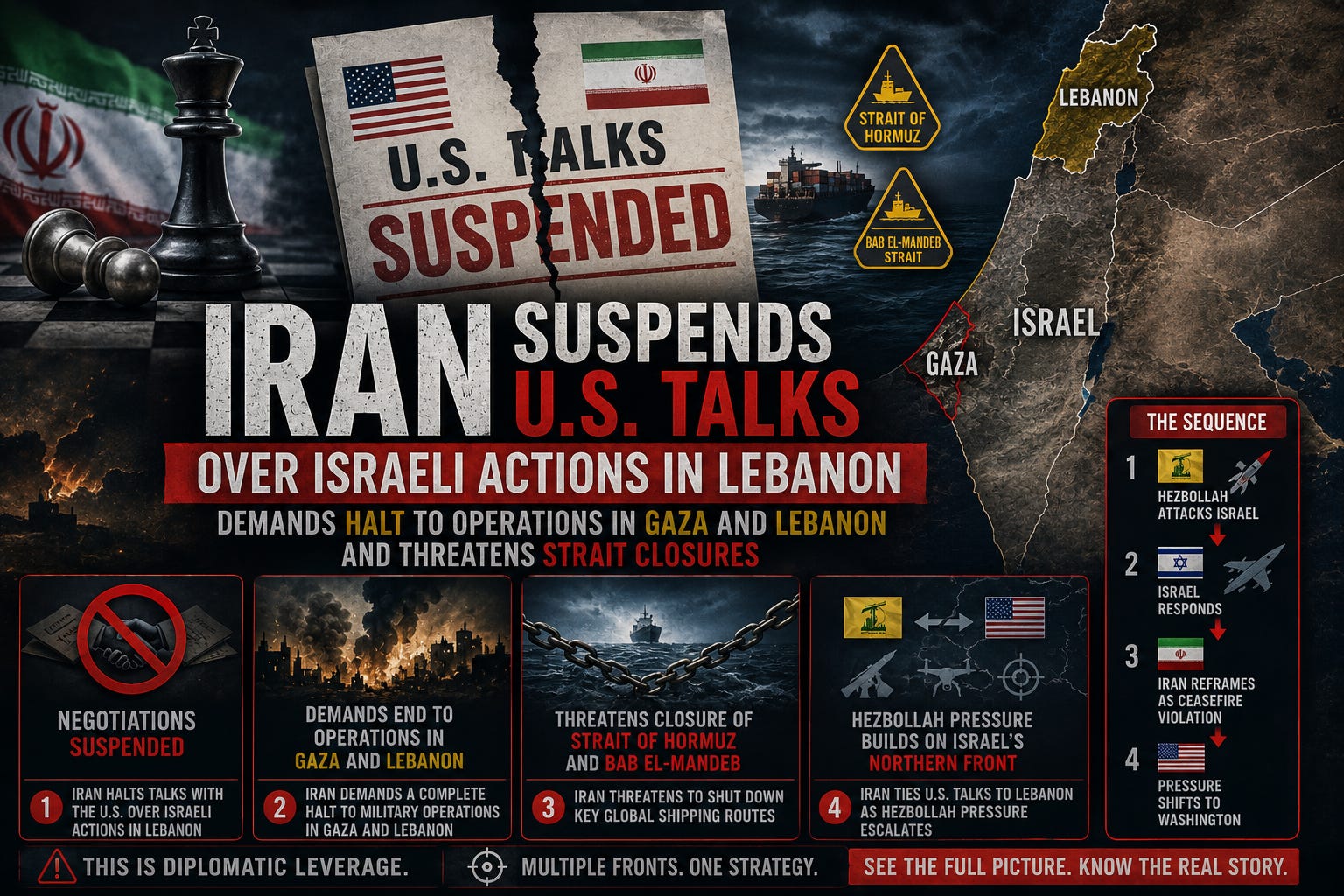
🚨 IRAN SUSPENDS U.S. TALKS OVER ISRAELI SUPPOSED ACTIONS IN LEBANON, DEMANDS HALT TO OPERATIONS IN GAZA AND LEBANON AND THREATENS STRAIT CLOSURES
‼️ IRAN ANNOUNCED IT SUSPENDS NEGOTIATIONS WITH THE UNITED STATES: According to Tasnim, Iran has halted negotiations with the United States in protest of Israeli activity in Lebanon.
Iranian Foreign Minister Abbas Araghchi stated: "The ceasefire between Iran and the US is unequivocally a ceasefire on all fronts, including in Lebanon. Its violation on one front is a violation of the ceasefire on all fronts. The US and Israel are responsible for the consequences of any violation."
🔸 IRAN SETS CONDITIONS: Iran says it has suspended all negotiations with the United States over what it describes as Israeli threats to attack Beirut.
Iran is demanding a complete halt to all military operations in Gaza and Lebanon.
❗️ IRAN THREATENS REGIONAL SHIPPING ROUTES: Iran says it is prepared to completely shut down both the Strait of Hormuz and the Bab el-Mandeb Strait.
♟️ IRAN TIES U.S. TALKS TO LEBANON AS HEZBOLLAH PRESSURE BUILDS ON ISRAEL’S NORTHERN FRONT: Iran is now attempting to define the Iran-U.S. ceasefire as a ceasefire “on all fronts,” including Lebanon.
The analytical question is not only what Iran is saying.
It is why Iran is saying it now.
For weeks, Hezbollah has continued attacks against Israel despite ceasefire efforts. Rockets, drones, anti-tank fire, and attacks on IDF forces have continued along the northern front. Israeli soldiers have been killed and wounded, and northern Israeli communities have remained under threat.
Israel’s position is straightforward: a ceasefire cannot require Israel to absorb ongoing Hezbollah attacks without responding.
That is also why the timeline matters.
Iran’s current framing focuses on Israeli operations in Lebanon, but largely removes the Hezbollah attacks that preceded them. This creates a narrower narrative in which Israel appears to be the party breaking the ceasefire, while Hezbollah’s role is pushed into the background.
There is also a broader strategic possibility.
Iran may benefit from Hezbollah increasing pressure on Israel’s northern front, knowing that Israel is unlikely to ignore repeated attacks on its soldiers and civilians. If Hezbollah escalates, Israel responds. If Israel responds, Iran can then point to Israeli action in Lebanon as proof that the broader ceasefire framework is being violated.
That does not prove Iran directly ordered every Hezbollah action.
But it does show how Hezbollah pressure can serve Iran’s diplomatic narrative.
By tying Lebanon to the Iran-U.S. ceasefire, Tehran is attempting to shift the burden onto Washington: restrain Israel, or Iran walks away from negotiations.
This is not only military pressure. It is diplomatic leverage.
Iran is trying to merge multiple fronts into one framework: Lebanon, Gaza, the Red Sea, the Strait of Hormuz, and negotiations with the United States. Under this model, Hezbollah’s actions become part of a wider pressure campaign, while Israeli responses are presented as the cause of regional instability.
That framing is highly selective.
A full reading of the situation must include the sequence:
Hezbollah attacks.
Israel responds.
Iran reframes the response as a ceasefire violation.
Pressure then shifts to Washington.
The central issue is not simply whether Israel acted in Lebanon.
The central issue is what triggered Israel’s action — and who benefits from presenting the timeline in reverse.
🔁 If this gave you clarity — forward it.
🌐 Full updates & discussion: https://www.israelrealtime.com


