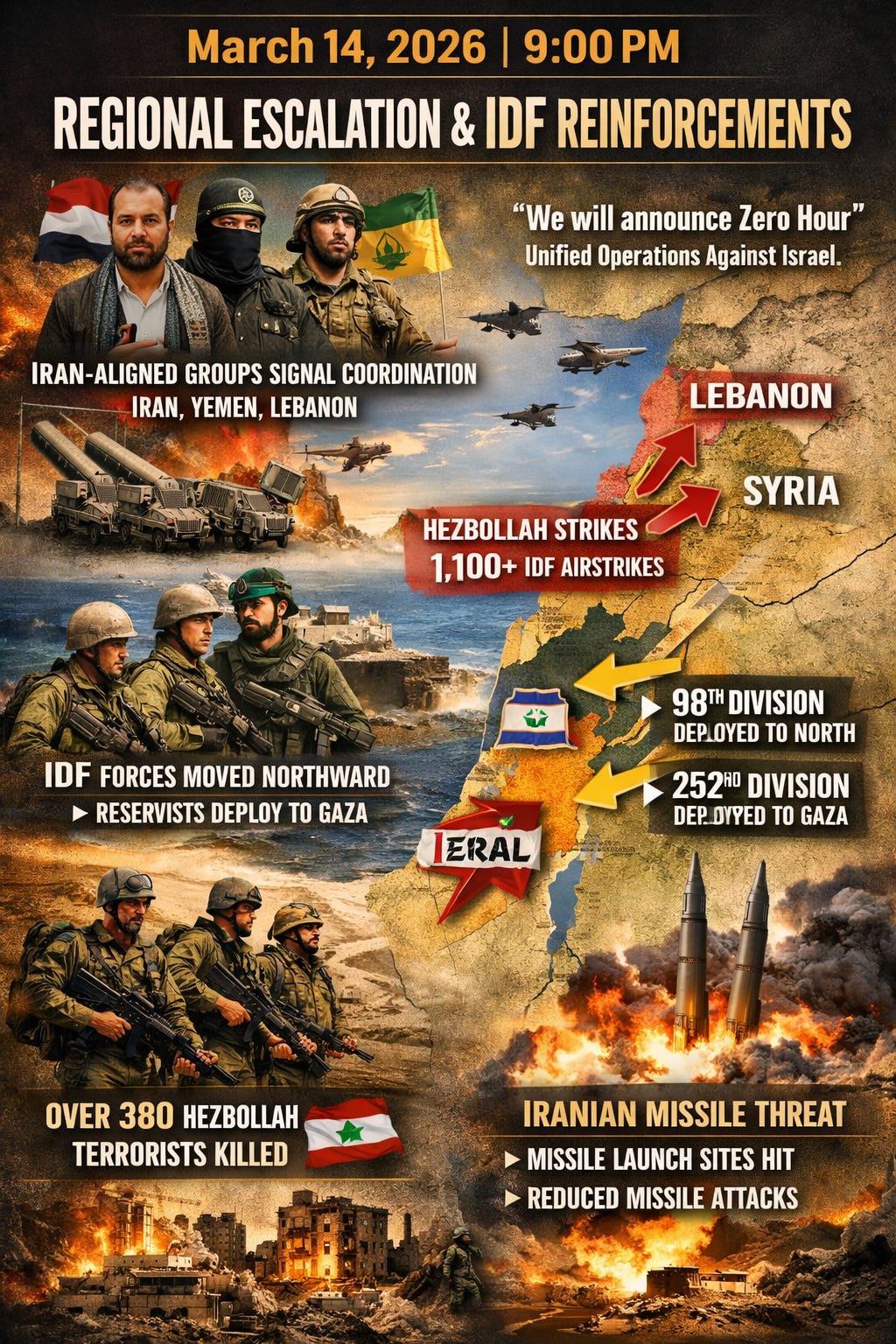
🛡️ IDF REINFORCES NORTHERN COMMAND AND SHIFTS FORCES BETWEEN FRONTS AS STRIKES DEGRADE HEZBOLLAH AND IRANIAN MISSILE INFRASTRUCTURE WHILE IRAN-ALIGNED GROUPS SIGNAL COORDINATED REGIONAL INVOLVEMENT
‼️ REGIONAL COORDINATION SIGNALS FROM IRAN-ALIGNED GROUPS: Israeli security officials report detecting movement of launch systems in Iran, Yemen, and Lebanon. The developments follow public statements from Iranian-aligned groups indicating possible additional involvement in the conflict.
Mohammed Al-Bukhaiti, a member of the Houthi Political Council, said: "We have decided to stand militarily with Iran and will announce zero hour at the appropriate time".
The deputy commander of the Houthi military forces stated: "Coordination between Iran, Hamas, Hezbollah, and Ansar Allah is done through joint operations rooms within the resistance axis; aiming to unify efforts against the Zionist entity in the region."
♟️ IDF REINFORCES NORTHERN COMMAND AND SHIFTS FORCES BETWEEN FRONTS: Following a new operational assessment by the Chief of Staff, the IDF is broadly reinforcing forces under Northern Command for both offensive and defensive scenarios.
The deployment includes standing army units from the 98th Division with two brigade-level combat teams and combat engineering battalions. To support the move northward, reservists from the 252nd Division will be mobilized and deployed to the Gaza Strip to replace standing army forces being reassigned to the northern front.
In the Central Command area, the IDF is also extending the duty period of several reserve battalions as part of broader readiness measures.
The reinforcements follow deeper troop deployments into southern Lebanon last week. The military said those deployments were intended to establish a forward defensive line and create an additional security layer for residents of northern Israel.
Since hostilities escalated earlier this month with Hezbollah launching attacks on Israel, the IDF says it has carried out more than 1,100 strikes across Lebanon. Targets included approximately 190 sites linked to Hezbollah’s Radwan Force, around 200 rocket and missile launchers, 35 command centers, and roughly 80 multi-story buildings used by the group.
According to the IDF, more than 380 Hezbollah and other terror operatives have been killed during the fighting.
🛡️ HEZBOLLAH LAUNCH FAILURE RATE AND DAMAGE IN LEBANON: Israeli assessments indicate that many Hezbollah launch attempts have failed. Out of approximately 1,550 launches toward Israel, about 670 crossed the border, while the rest fell inside Lebanon or failed during launch.
The IDF also reports destroying about 100 buildings in Lebanon so far during the fighting. That total includes around 70 in Beirut and approximately 30 in southern Lebanon.
🛡️ IRANIAN MISSILE FIRE DECLINES AS ISRAELI STRIKES TARGET LAUNCH INFRASTRUCTURE: The rate of Iranian ballistic missile launches toward Israel has declined in recent days. Iran fired roughly 90 missiles on the first day of the war and around 60 on the second day.
The rate then dropped to about 20 missiles per day for roughly a week and slowed further to only several missiles per day over the past day. The IDF attributes the reduction mainly to Israeli strikes targeting missile launchers and Iranian soldiers preparing attacks.
Despite the decline, the military assesses that missile launches may continue as long as the war remains active and that the pace could increase again.
The Home Front Command is also considering easing civilian restrictions in parts of Israel assessed to face lower risk from Iranian missiles or Hezbollah rocket fire. The move could allow schools to reopen in some areas.
A final decision has not yet been made and is expected when the current nationwide restrictions expire on Saturday night.
⏱️ If this update was helpful, please forward it to someone who relies on real-time information from Israel.
🌐 Read on web & subscribe by email: israelrealtime.com
☕ Support independent reporting: israelrealtime.com/p/donate