


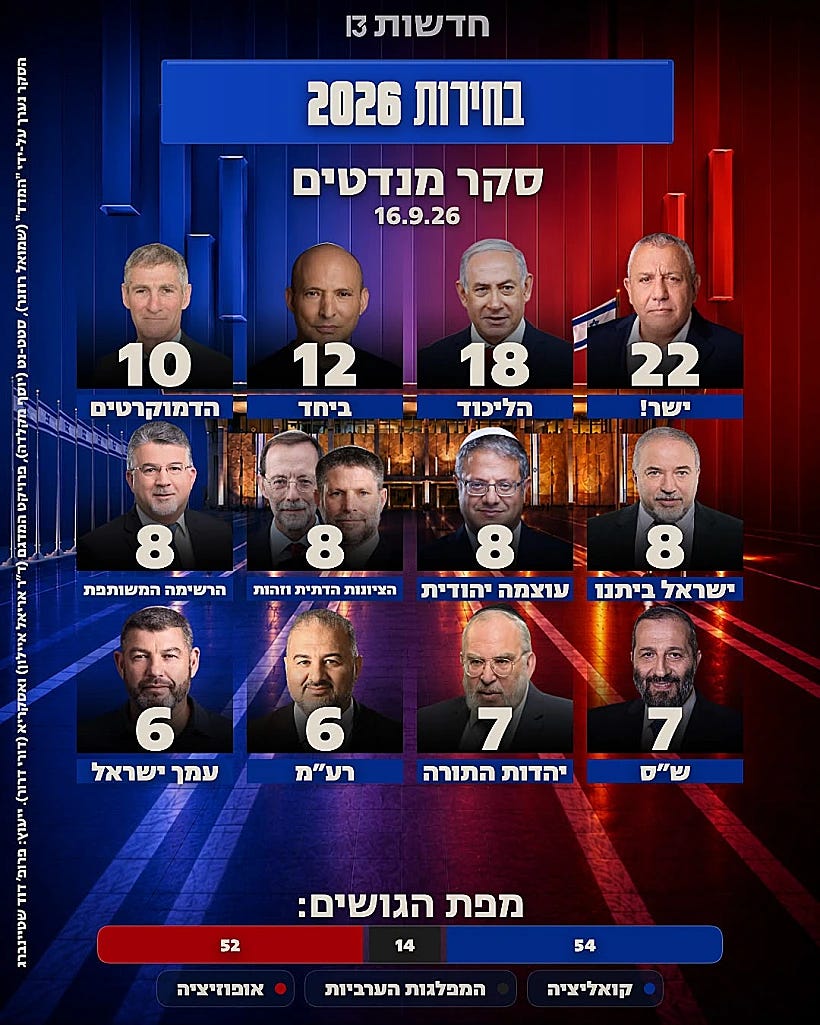
📊 Polling: divergent bloc projections and unresolved threshold risks: The September 17 evening polls left each pollster’s bloc totals unchanged. i24NEWS/Direct Polls put Netanyahu’s bloc at 60 seats, the non-Arab opposition at 48 and Arab parties at 12, matching September 9. Likud held at 27; Yashar fell from 22 to 21, Bennett from 10 to nine and Otzma Yehudit from eight to seven. Winter rose from four to five and Yisrael Beiteinu from seven to eight.
Channel 14/NEXT DATA retained 64 seats for Netanyahu’s bloc, 44 for the non-Arab opposition and 12 for Arab parties. Against September 15, Likud rose from 30 to 31, Eisenkot fell from 21 to 20, Bennett rose from eight to nine and Smotrich–Feiglin fell from eight to seven.
Earlier September 17 surveys placed Eisenkot ahead of Likud: 24–22 in Tatika and 22–20 in Kantar. Bennett received 14 and 13 respectively, compared with nine in both evening polls. Likud’s lead over Bennett therefore ranged from seven seats in Kantar and eight in Tatika to 18 in i24 and 22 in Channel 14. September 14 surveys showed different coalition arithmetic: News 12 gave Netanyahu’s bloc 50 and the non-Arab opposition 54, while Kan/Kantar put both at 52. Each counted 12 Arab-party seats and Hendel–Zelekha’s four separately.
Threshold exposure also varied. Winter received five seats in i24 and four in September 17 Kantar, but remained below the 3.25% threshold in Channel 14 at 2.6% and Tatika at 3.0%. Hendel–Zelekha rose to 2.2% in both evening polls but remained below the threshold. Smotrich–Feiglin received six to seven seats in the evening polls, against four in Tatika.
A separate Israel Hayom/Kantar survey of coalition preferences found that expected partners made 17% of respondents significantly reconsider, or become less likely to support, their chosen party. This exceeded one-quarter among Winter supporters and reached 32% among Hendel–Zelekha supporters, a sensitivity Israel Hayom described as potentially existential for both lists. The accompanying analysis emphasizes that i24’s 60-seat Netanyahu bloc includes Winter’s five seats, whereas Channel 14’s 64-seat majority already excludes him. Threshold changes cannot be translated into bloc totals by simply adding or subtracting projected mandates.
A Zman Yisrael summary gave the Change Bloc 55 seats, with Winter and Yaron Zelekha below the threshold. An undated weekly compilation, which did not define its paired blocs, listed Channel 11 at 52–52, Channel 12 at 54–50, Channel 13 at 52–54, Channel 14 at 46–64, Channel 15 at 48–60, Channel 16 at 53–52, Zman Yisrael at 55–51 and Israel Hayom at 52–52. Its Channel 14 opposition figure of 46 conflicts with the detailed September 17 figure of 44; the discrepancy remains unresolved.
The accompanying analysis identifies a possible weakening signal for Eisenkot, but no established national trend: he lost one seat in each evening series and two in Kantar, while Tatika raised him from 23 to 24. These mixed movements do not establish sustained erosion, and differences between pollsters do not themselves demonstrate rapid changes in support or a synchronized shift toward either camp.
🧾 Polling-station information and Elector ruling: The High Court overturned a Central Elections Committee decision and permitted polling-station party representatives to tell their parties which voters had voted. Likud condemned the court’s ruling regarding Elector, alleging a deliberate attempt to impair right-wing turnout and calling it a danger to democracy. It accused Solberg of contradicting his opposition to changing electoral rules mid-process and alleged that the court sought to remove right-wing rule because the next government was due to appoint ten High Court justices. Likud urged supporters to vote, saying the court would not decide for them.
🔁 Know someone who should see this? Forward it.
🗨️ Join the discussion, read on web & subscribe by email: https://www.israelrealtime.com/p/subscribe