
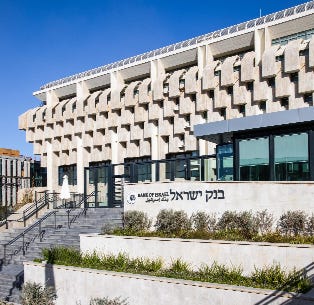
🏦 BANK OF ISRAEL POLICY BALANCE: Analysts describe the Bank of Israel’s upcoming interest-rate decision as one of the most complex since the war began. Policymakers are simultaneously balancing slowing growth, moderating inflation, fiscal expansion, geopolitical instability, and financial-market stability.
The shekel has strengthened sharply against the dollar, reportedly becoming the world’s strongest-performing currency against the dollar according to UBS. The stronger currency is reducing imported inflation significantly, while inflation in tradable goods is reportedly nearing zero.
Senior Bank of Israel officials and UBS analysts reportedly fear that continued shekel appreciation could eventually push inflation below the government’s lower target range. Reports indicate the central bank may consider renewed foreign-exchange intervention if the shekel strengthens further.
📉 ECONOMIC CONDITIONS: Israeli growth indicators continue weakening amid prolonged security pressures. First-quarter GDP reportedly contracted by 3.3% annualized during renewed conflict with Iran, while private consumption weakened and the Bank of Israel’s activity index declined for a third consecutive month.
Economists say businesses remain under strain from reserve mobilization, elevated financing costs, operational disruptions, and ongoing security uncertainty. Analysts also note that Israel’s real interest rates remain among the highest in the Western world, while exporters and the real-estate sector continue facing pressure from the stronger shekel and elevated credit costs.
⚠️ POLICY RISKS AND FISCAL PRESSURES: The Bank of Israel reportedly remains cautious about cutting rates too early. Policymakers are concerned that a rapid easing in fighting could release pent-up demand and reignite inflation pressures, potentially forcing future rate hikes.
Analysts also point to rising defense expenditures, widening deficits, election-related fiscal expansion, and growing political uncertainty as additional reasons for restraint. JPMorgan reportedly described the upcoming decision as “a very close call.”
📊 MARKET SENTIMENT: Israel’s five-year CDS risk premium has reportedly fallen below pre-judicial overhaul levels. Analysts remain divided over whether markets are accurately pricing geopolitical and political risks or are instead positioning for future regional stabilization.
Economists describe the current environment as “risk management under extreme conditions,” with policymakers balancing weak growth, falling inflation, war uncertainty, political instability, and market stability simultaneously without a clear low-risk policy path.
🇺🇸🇮🇷 US-IRAN NEGOTIATIONS: US officials told Fox News that Washington does not expect to finalize an agreement with Iran immediately, stating that negotiations are reportedly 95% complete and are now focused on final wording. Officials also said Tehran has reportedly agreed in principle to the framework.
Iranian Foreign Ministry officials stated that while large portions of the negotiations have reportedly been concluded, no agreement is imminent. Tehran also accused Washington of repeated policy changes and contradictory messaging that are disrupting negotiations.
🗣️ IRANIAN STATEMENTS: Iranian Foreign Ministry spokesperson Esmail Baqaei stated that the current focus of negotiations is ending the war rather than nuclear details. He said threats and pressure campaigns are part of US political tactics and insisted Iran would not yield to force or threats during negotiations.
Iranian parliament national security committee spokesperson Ebrahim Rezaei wrote on X: “Do not believe the bluff of the defeated president. Time is working against the Americans.”
🔁 If this gave you clarity — forward it.
🗨️ Join the discussion, read on web & subscribe by email: https://www.israelrealtime.com/p/subscribe


